Blown-In Insulation in Boulder, CO
Loose-fill cellulose or fiberglass that fills attics and existing walls evenly and fast — the efficient way to hit Colorado R-value targets.
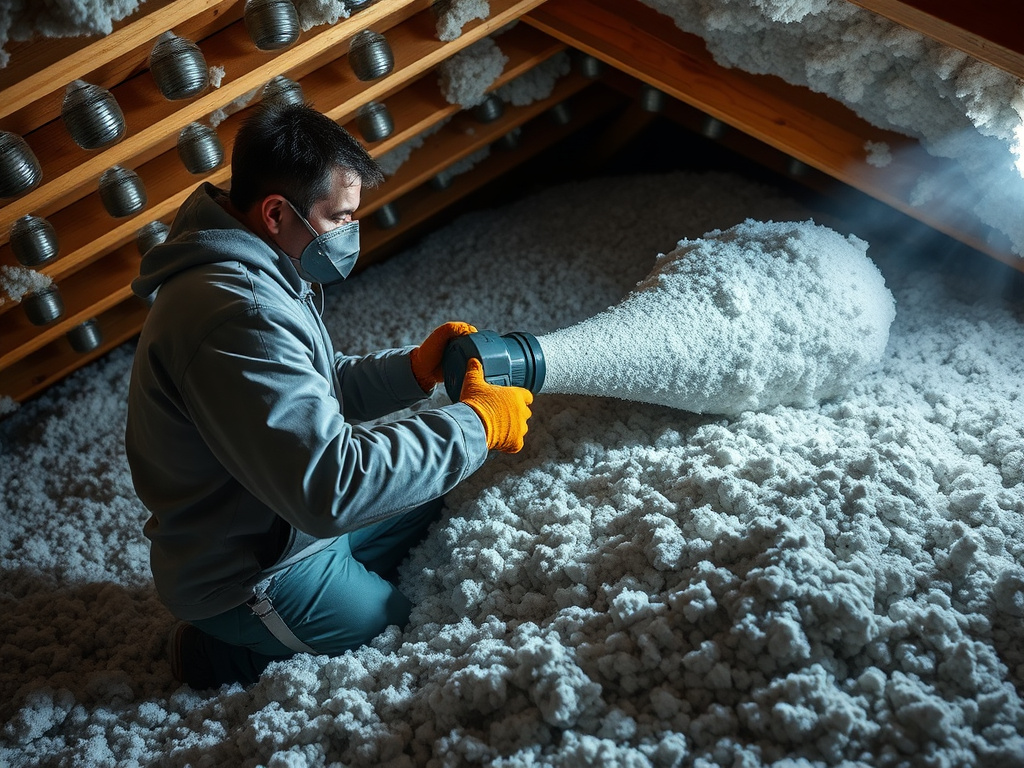
Blown-in insulation is one of the fastest, most cost-effective ways to raise a Boulder home's efficiency. Loose-fill cellulose or fiberglass is blown through a hose to fill attics and enclosed wall cavities, flowing around wires, pipes, and framing to create an even, gap-free blanket. For attics especially — where most of a home's heat escapes — blown-in is the go-to solution to reach the high R-values Colorado's climate demands.
Because it's installed as a loose fill, blown-in reaches into corners and irregular spaces that rigid batts can't, eliminating the gaps and compression that quietly rob batt insulation of performance. It's an ideal upgrade for existing homes where opening up walls isn't practical.
Why homeowners choose it
- Even, gap-free coverage that flows around obstructions
- Fast installation with minimal disruption
- Excellent for topping up under-insulated attics
- Cellulose option is made largely from recycled content
- Great value per R-value gained
- Can be dense-packed into existing walls without a full remodel
Cellulose vs. fiberglass loose-fill
Both cellulose and loose-fill fiberglass perform well; the right choice depends on the space and your priorities. Cellulose is made largely from recycled paper, is treated for fire resistance, packs densely, and is excellent at slowing air movement — a real advantage in Colorado's windy conditions. Loose-fill fiberglass is lightweight, won't settle as much over time, and resists moisture. For deep attic blankets we often recommend cellulose for its density and air-slowing qualities; for certain applications fiberglass is the better fit.
We'll talk through the trade-offs and recommend the material that gives your specific home the best performance for the money.
- Cellulose — dense, recycled content, slows air well
- Fiberglass — light, low settling, moisture-resistant
- Both reach high attic R-values efficiently
- We match material to the space and your goals
Hitting Colorado's attic R-value targets
Boulder County sits in a cold climate zone where the Department of Energy and local energy codes call for high attic insulation levels — commonly R-49 to R-60 for attics. Many older homes were built to far lower standards and have settled or thin insulation that leaves money on the table every heating season. Blowing in additional loose-fill to bring your attic up to a modern R-value is one of the highest-return improvements you can make, often paying for itself through lower bills.
We measure your existing depth, calculate what's needed to reach your target R-value, and install to an even, verified depth with a ruler card left in place so the result is documented.
Prep and air sealing come first
Blown-in insulation performs best over a properly prepared attic. Before we add insulation, we look for and seal the air leaks — around can lights, top plates, plumbing and wiring penetrations, and the attic hatch — because insulation slows heat but doesn't stop air movement. Skipping this step leaves the biggest efficiency gains on the table. We treat air sealing and insulation as a package so your new R-value actually delivers its full value.
Ideal for
- Attics that are under-insulated or below current R-value targets
- Existing walls that need insulation without demolition
- Older Boulder and Longmont homes with settled insulation
- Homeowners wanting a high-ROI efficiency upgrade
- Sloped ceilings and irregular attic geometry
What affects the cost
Blown-In Insulation questions, answered
Boulder County is in a cold climate zone, where recommended attic insulation is typically around R-49 to R-60. Many existing homes fall well short of that. We measure your current depth and top up to your target R-value, which for most under-insulated attics delivers a fast payback through lower heating and cooling bills.
Both work well; it depends on the attic and your goals. Blown-in loose-fill is a fast, cost-effective way to reach high R-values across a standard attic floor. Spray foam is the choice when you want to insulate at the roofline, seal a vaulted ceiling, or create a conditioned attic. We often pair air sealing with blown-in for the best value, and recommend foam where its air seal is worth the premium.
Usually yes. If your existing insulation is dry and in good condition, we can often add loose-fill on top to boost your R-value. If the old insulation is wet, moldy, damaged, or contaminated, we'll remove it first. An inspection tells us which path is right for your attic.
Some settling is normal, and we account for it by installing to the correct initial depth so your attic still meets its target R-value after settling. Cellulose settles more than fiberglass but packs densely; we install to documented depths so your rated performance holds up.
Blown-In Insulation done right, by a local Boulder crew
Blown-In Insulation isn't a commodity — the result depends entirely on how carefully it's planned and installed for your specific home and Colorado's climate. We assess what your house actually needs, prep and air-seal properly, and install to your target R-value, so the work delivers the comfort and savings it's supposed to. No shortcuts, no builder-grade rush.
We serve Boulder, Longmont, Louisville, Lafayette, Superior, Niwot, Nederland, and the rest of Boulder County, and we'll help you capture the Xcel and local rebates that bring your project cost down. Every job starts with a free, no-pressure quote.
Just as important, we treat your home like the system it is. Insulation, air sealing, ventilation, and moisture control all interact, and getting one right while ignoring the others leaves comfort and savings on the table. When we scope your blown-in insulation, we look at how it fits the whole picture — so the finished result performs the way it should, holds up through Colorado winters, and actually lowers the bills you feel every month. That whole-home mindset, plus honest advice about what your house truly needs, is what our neighbors across Boulder County count on us for.
Free assessment
We evaluate your home and give you a clear, itemized quote with rebates factored in.
Expert install
We prep, air seal, and install your blown-in insulation to spec — clean and on schedule.
Savings you can feel
A more comfortable home, lower bills, and help claiming every rebate you qualify for.
Related services
Ready for a free blown-in insulation quote?
Tell us about your home and we'll put together a clear, no-pressure quote — plus show you which Xcel rebates you qualify for.